Thursday, September 14, 2017

PARADISE IS A STATE OF MIND


What makes us happy? At one with the world? Content with our lot?  None of us will come up with the same answer - we will each respond to a different call - and that's how it should be.

Ask a dung beetle - her answer will surely be "face down in a fresh cow patty rolling a perfect ball to trundle home to the family".   Us humans are a little more diverse I would think - line up 50 people and pose the question and you would probably get 50 different answers.

My own philosophy - aspire to your own dreams and definitions of happiness without worrying about what the next person is doing.  No one should dictate, approve, or disapprove another individuals choices.  As long as the dream is within the bounds of socially appropriate behavior, and realistic in expectations, then all dreams or goals should be entertained and hopefully achieved.  

Diversity and variations on a theme make the world a happy place, if we would just let it happen.

Each to his own and each of us should let it be!  Just like the Beatles/beetles tell us. 

Thursday, June 29, 2017

AMERICA'S CUP


As stated on the official site: "The America’s Cup, sailing’s pinnacle event, is the oldest and arguably the most difficult trophy in the world to win. For the first time in its history, the 166 year old competition will be hosted in Bermuda."

Living in Bermuda has given us the privilege of participating in a world event that we would never have had otherwise.  America's Cup only comes round every four years and always in a part of the world where we have been unable to go.   Now, here it is - on our doorstep - how could we not attend!  Starting on May 26th through June 27th 2017, it has the whole island in its grip.  

All the harbours are filled with yachts, sailboats and megayachts from around the world.  Visitors are everywhere, and hotels and restaurants are filled to capacity.  Flags fly everywhere.  The excitement is almost palpable - smiling faces abound, music is in the air.  

The event itself is at Dockyard.  The American team US Oracle has been here for the last four years and we have often seen them out on the seas practicing and training on every sunny day that presents itself.  Now the teams from New Zealand, France, England, Japan and Sweden have set up camp as well.  The yachts are amazing to look at - catamaran style - but so far advanced in technology and design that they are a set apart from every other yacht I have ever seen.  Dockyard has been extended and refurbished to accommodate all the visitors.  Special events have been organized.  Huge tv screens are everywhere for those of us who don't have VIP seats. 

We loved watching the yachts perform their choreographed moves - looking so much like dancers on waves.   We had prime spots at the sea wall to watch the finish of each race.  I was cheerleading for US Oracle - they have done so much for children's education on the island.  Patrick was rooting for England. 

Sadly neither of us won - New Zealand took the cup and unfortunately for Bermuda, will take the event to New Zealand.

Nice to have another bucket list item checked.


Friday, April 14, 2017

LIVING ON THE ROCK


Locals refer to Bermuda as "The Rock'.   It's a rather apt description if you think about.  Topographically, we live at the top of a submerged mountain in the middle of the Atlantic.  The islands lie on top of an extinct volcano.  The so-called Bermuda Platform was also created by "reef building corals, vermetid snails and calcareous algae that colonized the eroding seamount" (1). 

Suffice it to say that the island is made up of a mixture of volcanic rock and limestone.  There are no fresh water rivers, and no lakes.  There are patches of land that are arable, but very little in the way of agriculture is possible.  The plants, trees and shrubs are lush and beautiful despite the hard rock beneath.

Despite its foundations, there are luxuriant golf courses and dense tropical nature reserves dotted all over.  Accordingly, living on 'The Rock' even with it's bowling ball core is a fabulous experience.


(1)  Introduction to Bermuda: Geology, Oceanography and Climate in Coral Reefs of the World 2013 P115 to 133

Tuesday, April 4, 2017

ISLAND PROBLEMS

Oh, the problems we endure whilst living on the island. 


To wit - this post seen lately via IWC Facebook: 
"Does anyone know of a coconut-removal service I could call to remove several bunches of coconuts from a very tall and thin palm tree? The tree is taller than our house and looms above my kids' outside play area. Our gardeners said it is too high for them to deal with..."

Oh, my heart - the trials and tribulations!  In my humble opinion, this makes me feel truly blessed!  How lucky we are to be beset by problems of this magnitude.   Do we truly appreciate the fact that most of us who live in countries of the Western world do not usually have to deal with obstacles and issues of earth-shattering significance?  

Most of us in the vicinity of North America have access to running water, organized public transportation, shelter, a variety of job options, a smorgasbord of food in the grocery stores - the big things are all there for the taking.  Opportunities and potential abound.

Now, that is not to say that all of us don't have to deal with the darker side of life: death of loved ones, consequences of accidents, health issues, and climatic calamities that nature throws our way.  

But truly, barring those awful events that all of us must deal with from time to time, I do believe that we should be grateful and thankful for the fortunate lives that the universe has dealt us. 

Time to smell the roses I think.... or the hibiscus here on the island.     


Friday, March 10, 2017

ARCHITECTURE ON THE ISLAND

One of the most distinctive features of Bermuda is the architecture.  Flying in to land at L. F. Wade International, an aerial view displays a sea of white, stepped pattern roofs.   A sight to behold - turquoise seas, lush greenery, and white roofs from one end of the island to the other. 


On the streets, wending your way down narrow roads,  you can see wave after wave of pastel, and brightly coloured houses.  Some homes are three and four hundred years old and are constructed with blocks of limestone, whilst the more modern versions are made of concrete block. 

Most of the designs reflect external chimneys and buttresses, peaked roofs with Flemish gables, low overhanging eaves and top-hung shutters.  Windows come replete with 'eyebrows' and 'lips'.  Front doors are usually solid wood, the older ones being hand-carved.  There is usually a porch with a welcoming stairway.  Gardens are filled with luscious tropical shrubs, palms, banana trees and frangipani trees.   Inside the century homes, there is usually a fireplace, wooden floors and open wooden joists in the ceiling.  Always loads of character and charm.  

St. George - the earliest capital of the island - from sometime in the 1600's - has been designated a UNESCO World Heritage Site.  No owner anywhere in the village is allowed to make any alternations or changes to the inside or outside of their buildings.  Renovations and repairs have to hold true to the original design.  


Not to be outdone, Hamilton, the 'new' capital, certainly has its charms as well. Front Street has its share of beautiful architecture reflected in the sun off the water in the harbor.  There are parks that provide peaceful and calming spots to sit and people watch: Queen Elizabeth Park, Victoria Park, Wesley Park and Barr's Bay Park with their carefully tended gardens, fish ponds, sculptures, and a gazebo or two.  


All in all, Bermuda's urban planners and architects are to be commended for a great job!  Better by far, than many so-called first class cities I have lived in. 

Our sojourn on the island will definitely be remembered for these white stepped roofs and pastel coloured houses.

Wednesday, February 22, 2017

HISTORY OF ST. GEORGE


Unesco describes the history of St. George much better than I could - so here it is for anyone interested:

My contribution - what a wonderful life experience to live in a town that is essentially the same as it looked 300 years ago.

"The Town of St George, founded in 1612, is an outstanding example of the earliest English urban settlement in the New World. Its associated fortifications graphically illustrate the development of English military engineering from the 17th to the 20th century, being adapted to take account of the development of artillery over this period.Some of these are unique as surviving examples of the first defensive works built by early European colonists, few examples of which now remain intact. The later associated forts represent an excellent example of a continuum of British coastal fortifications.

The permanent settlement of St George began in August 1612. The inscribed area consists of the Town of St George on St George Island as well as fortifications on the Island and on a number of small islands commanding access to the Town and to the anchorage of Castle Harbour, at the eastern end of the Bermuda Islands in the North Atlantic. The layout of the Town is one that has grown organically over nearly four centuries. At its heart is King's Square (or Market Square), adjacent to the harbour, and providing the link between the harbour and the two main east-west roads that connect the Town with the rest of Bermuda: Water Street, giving access to the quays, and York Street to the north, the main street of the Town.


The streets to the north provide a network of what began as narrow, winding lanes and alleys. The architecture of Bermuda is unique, and has changed little in its basic elements since the end of the 17th century. Different from other European-founded cities of the New World, St George has maintained the individually separated house for habitation, so typical of the English settlements in North America. Because of the nature of the soft limestone that continues to be used for construction, walls, including roofs, are white-washed. Buildings rarely exceed two storeys and many are only one storey in height. Since sources of water are scarce on the island, the white colour of the roofs and pitch are designed to collect rain water into cisterns through gutters and other conduits adding to the unique appearance of the Town.

St George was a garrison town from its earliest days, and military installations developed on the eastern side of the Town. The first of many barracks were built on Barrack Hill in 1780, and ancillary buildings, such as residences for senior officers, officers' messes, hospitals and a garrison chapel followed during the course of the 19th century. These were constructed in the standard British military style but using local materials. The related fortifications began in the early 17th century, with forts on Paget, Governor's, Charles, and Castle Islands. These were repeatedly reconstructed and strengthened during the course of the 17th and 18th centuries.


At the end of the American Revolution, Britain made St George's Island its main New World naval base. The existing fortifications were radically redesigned and rebuilt in the 1780s and 1790s. Work began on the dockyard at the turn of the century, necessitating further drastic changes in the system of fortifications, with the construction of Forts George, Victoria, St Catherine, Albert, and Cunningham (on Paget Island). The advent of rifled artillery in the 1850s led to yet further modifications and strengthening of the fortifications.

http://whc.unesco.org/en/list/983


Tuesday, January 31, 2017

BERMUDA MYSTERY ROSES


Many years ago, settlers to the land of Bermuda brought roses from their homelands to plant in the landscape. 

As the story goes, the history of the roses were lost, thus becoming "mysteries".


The rose bushes are everywhere on the island - nearly every garden and park seems to display at least one vibrant rose.  The Botanical Gardens are especially lovely with their sweeping gardens and green rolling lawns. 


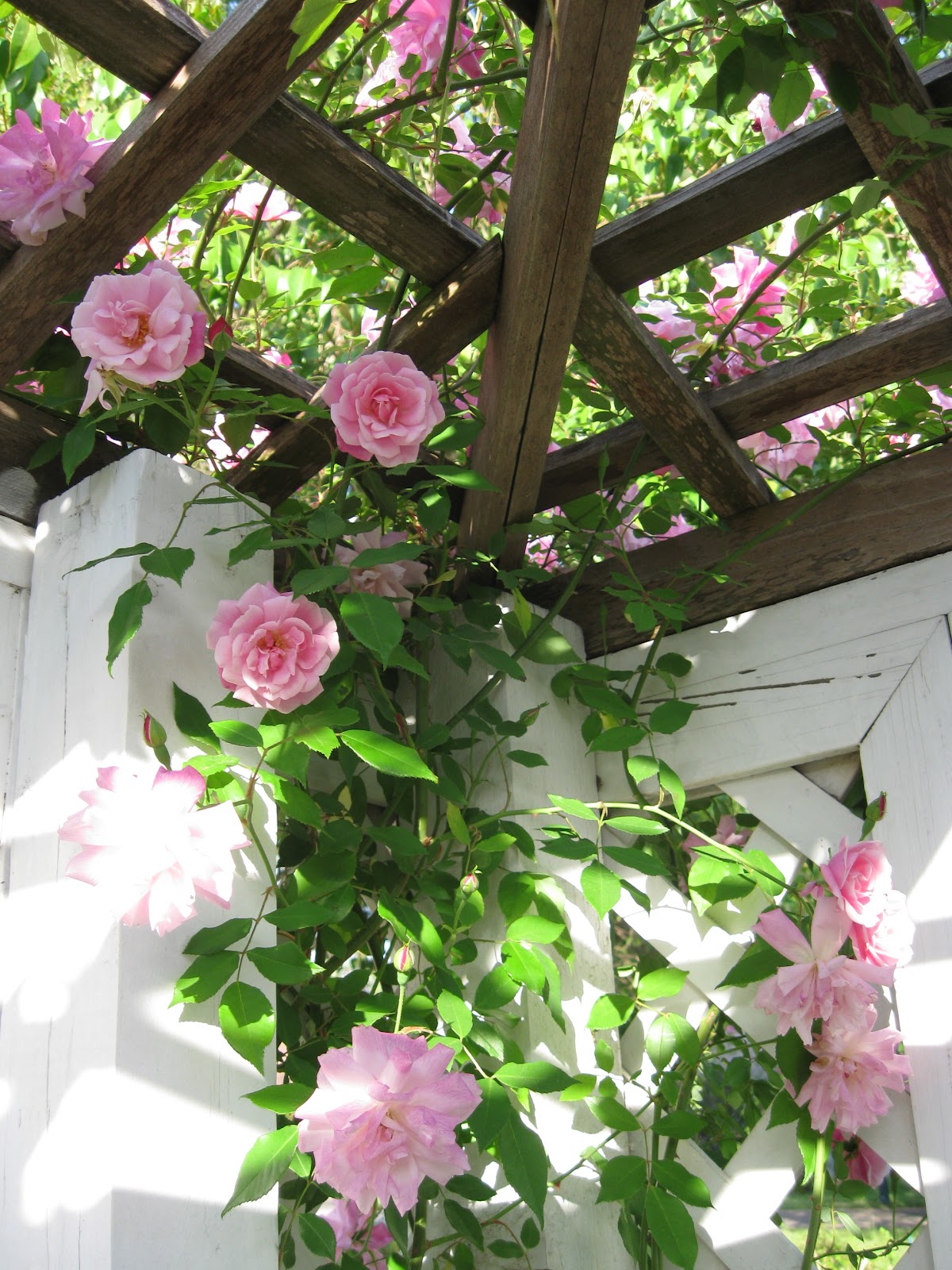
The roses start blooming in October in a wild array of colours and types - heavy headed multi-petal blooms and the delicate single circle.  They climb vigorously over walls and hang from pergolas in glorious abandon.

As you walk by, the heady scent of flora catches your breath.  No wonder there is a perfumery on the island.

Ah, everything coming up smelling like roses!