Saturday, May 28, 2016

HUMAN PENGUINS?


We are seeing a lot more action on the beaches.  Although, not so much the beaches - we have always encountered someone walking on the beaches, even on colder, blustery days.  However, there is now a noticeable difference in numbers of people actually taking to the water and swimming, diving, and snorkeling. 

We have been told that locals don't typically use the beaches from Labor Day in September right through to May 24 which is Bermuda Day.  Word is that any temperature reading under 80 degrees Fahrenheit is considered far too cold for them.    In the summer months, sea temperature is an average of 80 degrees F, and warmest in August at about 85 degrees F. Agreeable temperatures for all, hence lots of locals on beaches everywhere.

In the winter months of November and December the temperature takes a dip to about 70.   January to April usually registers a frigid 66 degrees F.   Now, we didn't swim from January to April either, but I have it on good authority that swimming is still excellent at 70 to 80 degrees F - can't say I disagree.  It just takes that inch-by-inch torture and the final dunk and I can do it too I am sure. 

So until January, I will join the throngs of ex-pats for an invigorating bathe in the ocean, whilst the locals look on aghast. 

There's a reason that Bermudians call Canadians "human penguins".  


Tuesday, May 24, 2016

BERMUDA DAY 2016


Bermuda Day falls on May 24th.  It used to be called Victoria Day and then Commonwealth Day.  The island is not an independent nation as it still falls under the British Overseas Territories.   However, it is internally self-governing with an island parliament.  The Head of State in Bermuda is the Governor appointed by the Prime Minister of  England and represents the British monarch Queen Elizabeth II.  The current Governor is George Fergusson who has been in office since 2012. 

The current head of Bermuda government is the Premier, Mr. Michael Dunkley.  There is a House of Assembly, with 40 elected members, as well as a Senate with 11 appointed members.  There is also a system of local government with the island divided into nine parishes, each one headed up by an elected Mayor. 

We live in St. George - claim to fame is that it is the fifth oldest municipality in the Western hemisphere founded by British Admiral Sir George Somers in 1609.  Earlier municipalities include St. John's Newfoundland, Annapolis Royal in Nova Scotia and Montreal.  Pretty long history I would say and nice to see the connection to Canada.

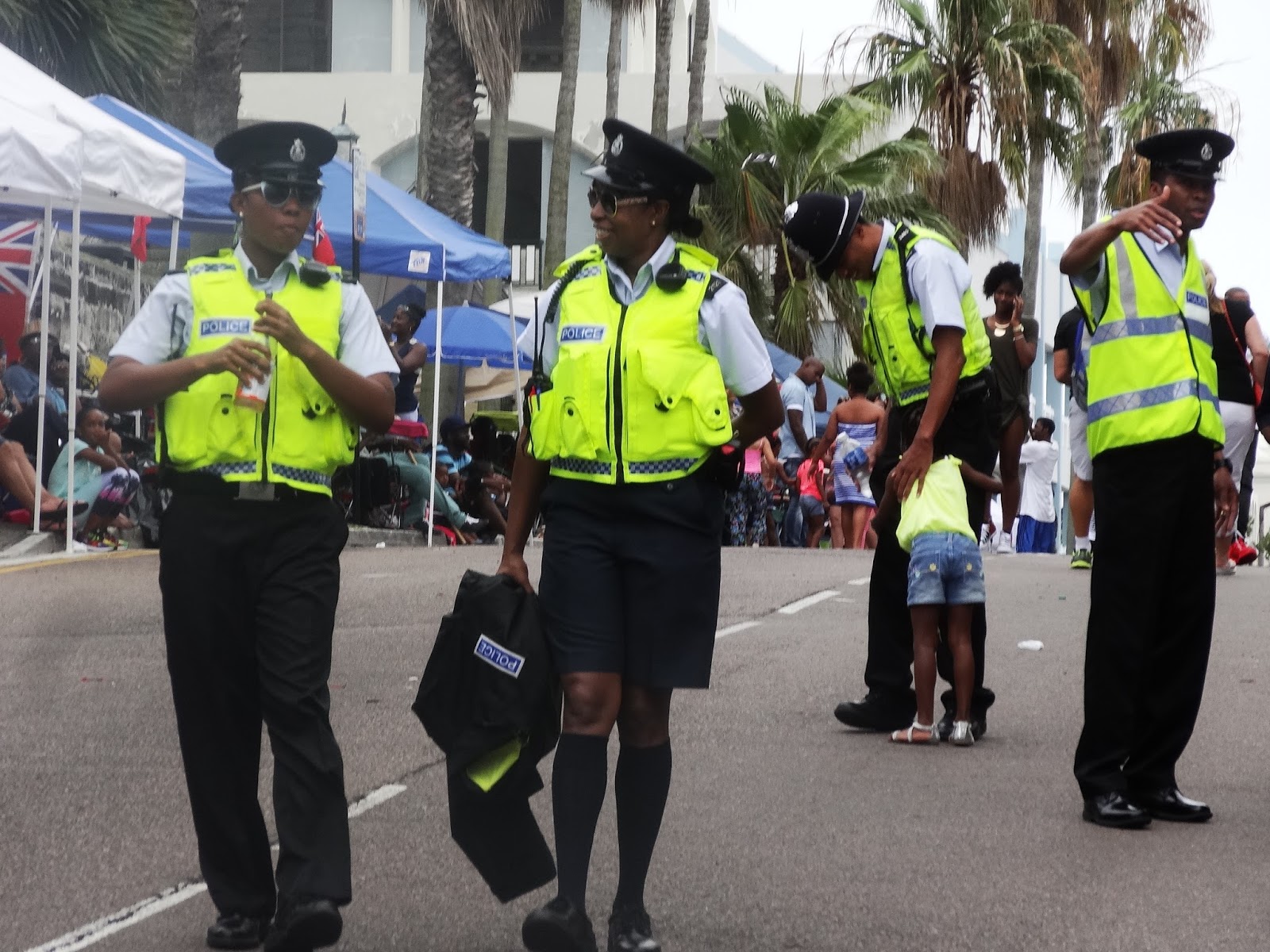
So much for history.  On this day in 2016, we found ourselves bouncing along on the winding lanes on a bus headed to Hamilton to watch the day's festivities.  Parking is not our friend on busy days in Hamilton.  It seems everyone else had made the same decision to attend, as we arrived to banks of people lining the main thoroughfares of Front Street, Queen and Church Streets.  Obviously settled for the day, families were parked under huge shade tents and umbrellas, armed with large coolers, and copious amounts of pop and ice. 

We sat watching a somewhat disorderly parade of various dance groups, bands and cheerleaders.  A very happy crowd observing very relaxed and happy participants.  Met the Gombeys for the first time:  a very unusual group of musicians and dancers.   Dancers can be traced to a mix of Afro-Caribbean and Native American influences.  In a tribute to history - all of the body and faces of the dancers are covered to avoid identification, as slave-owners frowned upon the practice of their slaves participating as Gombeys.  Lots of use of drums and bottle-whistles that soon had the crowds dancing and swaying to the beat.  

All in all, a great day celebrating with  Bermudians. 


Sunday, May 22, 2016

HITTING THE BEACHES


Quest - to walk or swim on every beach possible in Bermuda.  We made some headway on Saturday - a worthwhile afternoon, despite the wind and the overcast skies.  We started with the southern shores of the island and drove westward. 

We came upon Elbow Beach first - a fabulous long shore line with sand as soft as corn flour, and the water a sparkling turquoise blue.  With the wind up the waves dominated, creating a white surf of warm water.   It is a very popular beach for families with young children, as well as kite surfers.  Then it was on to Warwick Long Bay - an even longer stretch of sand that reflected a soft hue of pink. Less busy than Elbow, perhaps because of a strong undercurrent.  Finally, we stopped at Horseshoe Bay - a real mecca for tourists and residents alike.   A toddlers delight is the little tidal pool sheltered from the waves by tall volcanic rocks.  Parking for buses, taxis and cars and a little beachside eatery called Rum Bum Beach Bar.  We had a great burger lunch for a reasonable price.     

We had heard of the "pink beaches" of Bermuda - and it really is true - not every beach mind - but those south shore beauties boast a definite showing of pink.  According to my research this occurs where there is a lot of wave action and reefs that are close to shore.  In a symbiotic dance with nature, the waves deposit the skeletons of tiny, bright red organisms called Red Foram or Foraminifera that had previously clung to the undersides of reefs.  They wash up on the beaches and mix with white sand, and pounded coral and shells to create the distinctive pink sand.  

As an aside, we will not be able to use the car in the height of summer when everyone will have the same idea as us and there is very little parking anywhere.  Horseshoe probably has the most parking at about 30 or 40 spots. Other than that we found parking for just 2 to 5 cars usually.  Sometimes it will mean just pulling over and parking on a grass verge - which are few and far between.  So it will be the bike or the bus for most of our trips to the beach.


Saturday, May 21, 2016

WHAT'S IN A NAME?

Driving around the island, I am struck by the quaint and whimsical street names that pop out at every curve of the narrow roads.  How could you not be smiling when you meander down Happy Talk Lane?   What about Finger Point Road - surely there must be something at the end of that road to satisfy the curious - what might it be pointing out?  Billy Goat Hill - a reminder of childhood nursery rhymes surely?  Maybe even Witchery Drive, or Step Mother Drive, and Old Maids Lane.

Slippery Hill, or Wreck Hill - watch out there!.   Then there is Featherbed Alley, and Sleepy Hollow Drive.  What about Sofar Lane, or Well Bottom Lane?  Can you imagine the cottages in Tea Rose Lane?  Not so sure about Smallpox Bay.  Maybe not the longwinded Scribes and Pharisees either.  Did someone just get tired of naming new streets - No Name Lane?  The unique:  Cockroach Rock, Monkey Hole, Hungry Bay Lane.   The sentimental: Peace Haven Drive, Loyalty Lane.  No doubt there is a story behind Pain Lane and Suffering Lane - in close proximity to each other no less. 

Some distinctly military type road names attesting to a bygone era when Bermuda was a British Navy stronghold - like Grenadier Lane, Soldier Point, Sentinel Hill, Redcoat Lane, Military Road, Khyber Pass, Gunner Bay, Battery Close.  Add the piratical to that as well - Pieces of Eight Alley.

And then there are some of the island names: World's End Island, or Stipple Island.  Followed by Rabbit, Mouse, Duck, Goose, Hen and Turtle Islands. - sounds like someone was going to bat for the more humble animals.  And not to leave out the quaint: Little Crumb Island, and Little Rogue Island.

And last, but not least: we live on Convict Bay Lane.

A LITTLE BIT OF HOME

On Sunday, we spent a leisurely morning in the living room pottering around and relaxing on a bit of a rainy and overcast day.  When, lo and behold, we look out the window and what do we see but two mine sweepers gliding by.  Too interesting to miss the opportunity of getting a better up close look at them, we sauntered down to the dock to check them out.

What a sight to see - two Canadian ships with Canadian flags fluttering about in the wind and the decks of both filled with busy sailors.  The Moncton and the Saskatoon both in the harbor on their way to exercises down south apparently.

According to Wikipedia, they are known as coastal defense vessels that were launched in the 1990's.  They are used for coastal surveillance, sovereignty patrol, route survey, counter narcotics and training.  Their original role was supposed to be that of minesweeping.

Quite imposing and just lovely to see a little bit of home.


Friday, May 20, 2016

FIRST BIKE RIDE


Patrick came home a little early today so - for my first time - we hopped on the bike and made our way to Tobacco Bay.  
A bit hair raising - I haven't been on the back of a motor bike since my early twenties.  Many years and a much wiser brain tells me that caution is required.  The roads are very narrow and winding, and even though Patrick was puttering along at the sedate speed of about 40 kilometers per hour, it still felt like I was on a racetrack.  Every time the bike banked to enter a turn my heart lurched.   Every time I looked ahead I was grateful that traffic on the right kept to their side.   So much to worry about - the speed, the corners, the winding roads, the narrowness, the bus coming at us, what if he has a speed wobble, this helmet is suffocating - all those thoughts and more were going a mile a minute in my head - felt like the gyrations of a washing machine - round and round at high speed. 


Five minutes after we started, a real feeling of relief when we pulled up at Tobacco Bay. Had a great swim in warm and calm waters.  And then the trip home again - felt somewhat better.  Maybe I will get used to this - scratch that - will have to get used to this, as there are many places on the island that just do not cater for cars. 

Wednesday, May 18, 2016

WHITE ROOFS

Geologically speaking, Bermuda originated from submerged oceanic volcanoes.  A limestone cap was formed and due to the porosity of limestone, rainwater very quickly drains right through to mix with the salt water in the water table.  Added to that problem, is that there are no freshwater rivers or lakes - all standing water ponds are brackish in taste because of the mixture of rain water with salt water.   Despite the lack of fresh water, the island is green and lush with tropical plants - because of a consistently high rain fall throughout the year. Bermuda really depends on weather for its survival. 

In order for people to thrive on Bermuda, an ingenious method of accumulating rain water was devised by settlers 350 years ago.   To this day, inhabitants collect water from the roofs of their houses.  Roofs are typically made of white limestone and have grooves or furrows.   These limestone roofs serve to capture the rain water, filter the water as it passes through the limestone grooves (limestone providing bleaching effect), and finally storing it in underground tanks as drinking water.

This is still the most widely used method of creating drinking water in the island where there is no fresh water lake or supply source. The underground reservoirs are generally created under the bedrooms or living room and not under the kitchen or bathrooms. However, in the earlier days the water tanks were created above the ground and were made of stones structures. There is also a system whereby seawater is created into purified water by a process of reverse osmosis (don't ask me how that works).  There are also wells dotted all over the island, but the water can only be used for washing and flushing.

By law, all private dwellings, apartment complexes and businesses must have their own water tanks to collect and store rainfall - the size of which is mandated by local regulations. Homes can store about 14,000 gallons per bedroom.  Perhaps this is one of the reasons for the exorbitant prices of homes as the cost to build these tanks is the responsibility of each property owner. The import duty of about 30% on all building materials can result in much higher costs for construction.  Also wondering how they keep the water pure and clean in the tanks?

Most property owners keep their roofs in pristine condition so that water remains clean.  It is a common sight to see painters on rooftops making sure that the roofs continue to sparkle and gleam in the sunshine.   Also, we often see Government water trucks that can come and top up water tanks between rain falls. 

Style and substance in all those white roofs.  A sight to behold.